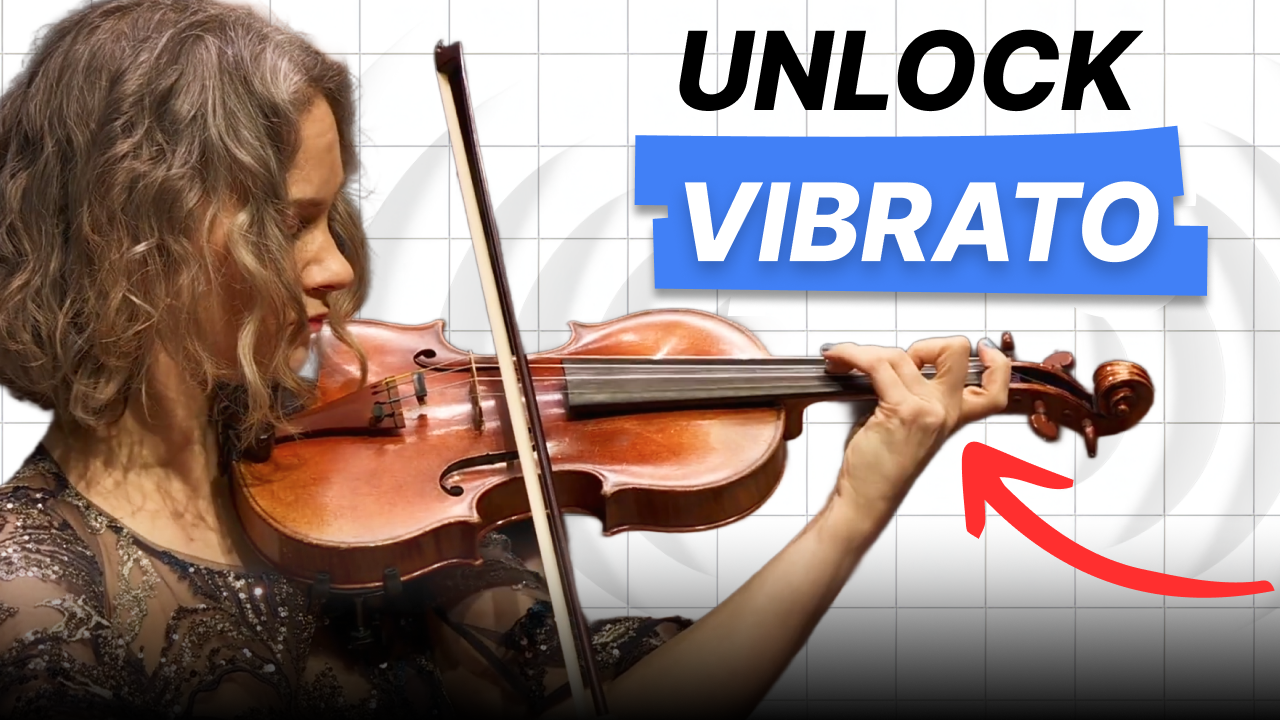
Why don’t you sound like a pro yet? The honest answer is almost absurdly simple: music is a language, and great players make the instrument sound like a speaking voice. Every technical thing you practise is in service of that one goal — a tone that carries meaning, not just notes.
Across more than a decade of teaching conservatory-level students, I’ve watched the same three things separate professionals from everyone else. None of them are secret — they’re hiding in plain sight. I’ll break each one down, show you what star performers actually do with it, and give you a way to practise it. The first is the most important, and the most overlooked.
The Sounding Point
The sounding point is the narrow strip of string between the bridge and the fingerboard where the bow actually touches. It’s tiny, but it decides your tone before the left hand does anything. Finding the right spot is like finding the right tone of voice in a conversation — it’s what makes your message land.
Carl Flesch mapped it as five contact points. At the bridge is sul ponticello — sharp and glassy. Just off the bridge the sound is at its most direct and powerful. The central point of the string gives the fullest resonance. Near the fingerboard the tone thins out, and over the fingerboard is sul tasto — soft and veiled. But the real skill isn’t naming them; it’s knowing when to use which.
Flesch gives three factors to choose by — and you can hear all of them if you compare Hilary Hahn and Janine Jansen in the opening of the Tchaikovsky concerto, two players reaching completely different places with the same notes. The first factor is bow-stroke length: long strokes want the bridge, fast whole-bow strokes want the fingerboard. The second is dynamic: forte lives near the bridge, piano near the fingerboard. The third is position: stay between the two down low, and move toward the bridge as you climb.
The fix nobody wants
Most players — even advanced ones — are quietly afraid of the bridge, because the sound is harder to control there. Check your “white rosin mark”: if it always sits near the fingerboard, that’s you. Train to be comfortable at the bridge — it’s where the tone stays direct and clear over a full orchestra.
Intonation
Tape this to your case, from Jascha Heifetz: “I do not always play in tune; I just fix it quicker than anyone else.” Everyone plays out of tune. Professionals simply correct faster. Intonation isn’t about being perfect — it’s about how fast you react.
Three steps make that reaction possible, and the third changes everything. First, a stable left-hand frame: keep the centre of gravity between your second and third fingers and let the thumb, wrist, and elbow follow it into every position. Second, finger placement: fingers hover over the string in a ready position and fall with weight, not force — force is inconsistent, and it chokes the resonance.
The third step is the quiet secret: build your intonation around the sympathetic vibration of the open strings. Tune your G, D, A, and E notes until the whole instrument rings, then fit everything else around that. Your pitch locks to the nature of the violin first, and only then adjusts to the pianist or the orchestra. It’s exactly the ringing intonation you hear from Augustin Hadelich and Clara-Jumi Kang in the Brahms.
Key insight
Practise it slowly, a few notes at a time, no vibrato — lots of bow, light pressure — just hunting for the ring. Take a whole piece through this once and the sound becomes addictive.
Bow Articulation
The last aspect is how pros make the language clear. They articulate letters, words, and sentences — notes, phrases, and finished musical thoughts. The idea that changed my own playing: look at every single note from three angles — its attack, its development, and its ending. Hear a note that way and your whole articulation sharpens.
There are three steps, easiest to hardest. First, read the articulation already written in the score — it lives in the spaces between the notes. Second, decide the attack each stroke needs; legato, spiccato, and martelé all begin differently. Third — the hard one — make clean transitions between them, shaped by style and taste.
Compare Maria Dueñas and Guido Sant’Anna in the opening of Lalo’s Symphonie espagnole and you’ll hear two players making opposite choices about where to be strict and where to soften — both completely convincing.
To train it, try what I call Stop and Go: map every gap between strokes, then play and stop at each change of articulation, using the pause to read and prepare the next attack before you finally smooth the transitions. You can’t articulate a musical thought you haven’t first seen on the page.
Free AuditionReadiness Check
Play me your hardest passage · 30 min · 1-on-1 · live
You play the passage you're worried about.
It doesn't need to be polished.
I give you one specific fix.
We try it together, so you hear the difference.
You learn where you honestly stand.
And what to work on first.
For violinists who can already play through their audition program.
Book Free 30-min Call